#include <spinAccumulationSolver.h>
Public Member Functions | |
| spinAcc (const Settings &mySettings, Mesh::mesh &_msh, const double _tol, const int max_iter) | |
| void | boundaryConditions (void) |
| bool | compute (const Nodes::step k=Nodes::NEXT) |
| std::vector< double > | potential (const double factor) const |
| void | checkBoundaryConditions (void) const override |
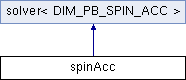
 Public Member Functions inherited from solver< DIM_PB_SPIN_ACC > | |
| solver (Mesh::mesh &_msh, const std::vector< Tetra::prm > &_pTetra, const std::vector< Triangle::prm > &_pTri, const std::string &name, const double _tol, const bool v, const int max_iter, const std::function< bool(Mesh::Edge)> &edge_filter=[](Mesh::Edge) { return true;}) | |
Public Attributes | |
| double | jn_multiplier = 1.0 |
| std::vector< Eigen::Vector3d > | s |
Private Member Functions | |
| void | fillDirichletData (const int k, Eigen::Vector3d &s_value) |
| double | getMs (const Tetra::Tet &tet) const |
| double | getSigma (const Tetra::Tet &tet) const |
| double | getPolarizationRate (const Tetra::Tet &tet) const |
| double | getDiffusionCst (const Tetra::Tet &tet) const |
| double | getLsd (const Tetra::Tet &tet) const |
| double | getLsf (const Tetra::Tet &tet) const |
| Eigen::Matrix< double, Nodes::DIM, Tetra::N > | calc_u_nod (const Tetra::Tet &tet) const |
| void | prepareExtraField (void) const |
| bool | solve (void) |
| void | integrales (const Tetra::Tet &tet, Eigen::Matrix< double, DIM_PB *Tetra::N, DIM_PB *Tetra::N > &AE) const |
| void | integrales (const Tetra::Tet &tet, std::vector< double > &BE) const |
Private Attributes | |
| std::vector< double > | valDirichlet |
| std::vector< int > | idxDirichlet |
| std::vector< double > | V |
| double | V_D = 0.0 |
| const int | precision = 8 |
| Nodes::step | uStep = Nodes::NEXT |
Additional Inherited Members | |
| Protected Member Functions inherited from solver< DIM_PB_SPIN_ACC > | |
| algebra::MatrixShape | build_shape (const std::function< bool(Mesh::Edge)> &edge_filter) const |
| void | buildMat (std::array< int, N > &ind, Eigen::Matrix< double, DIM_PROBLEM *N, DIM_PROBLEM *N > &Ke) |
| void | buildVect (std::array< int, N > &ind, std::vector< double > &Le) |
| Protected Attributes inherited from solver< DIM_PB_SPIN_ACC > | |
| Mesh::mesh * | msh |
| const int | NOD |
| const std::vector< Tetra::prm > & | paramTet |
| const std::vector< Triangle::prm > & | paramTri |
| const bool | verbose |
| algebra::iteration< double > | iter |
| algebra::SparseMatrix | K |
| std::vector< double > | L_rhs |
| Static Protected Attributes inherited from solver< DIM_PB_SPIN_ACC > | |
| static const int | DIM_PB |
Detailed Description
container for Spin Accumulation constants, solver and related datas. The model obeys the diffusive spin equation. User has to provide through mesh and settings at least one surface where spin diffusion vector s is a constant (zero recommended): Dirichlet boundary condition, and at least one surface where the current density jn is defined; if a spin polarization uP is also given on such a surface (and no s), the spin injection is a flux (Neumann) boundary condition. These surfaces are the ones given to the potential solver for its own boundary conditions. A surface may have both jn and s (s is then imposed on it).
Constructor & Destructor Documentation
◆ spinAcc()
| spinAcc::spinAcc | ( | const Settings & | mySettings, |
| Mesh::mesh & | _msh, | ||
| const double | _tol, | ||
| const int | max_iter | ||
| ) |
spin accumulation constructor if mySettings.spin_acc bool is false it is a do nothing constructor
- Parameters
-
[in] mySettings [in] _msh ref to the mesh [in] _tol tolerance for bicg_dir solver [in] max_iter maximum number of iterations
Member Function Documentation
◆ boundaryConditions()
| void spinAcc::boundaryConditions | ( | void | ) |
Dirichlet boundary conditions: all the surfaces with a fixed s (the surface with fixed normal current density J and polarization vector P, without s, is a flux condition, added to the RHS in solve()) set valDirichlet values and fill vector of indices idxDirichlet
◆ calc_u_nod()
|
private |
nodal magnetization of the tetrahedron (step uStep, see compute()) used by the spin diffusion problem, columns are the nodes
◆ checkBoundaryConditions()
|
overridevirtual |
check boundary conditions: mesh and settings have to define at least one surface with a normal current density jn and at least one surface where the spin diffusion s is given
Implements solver< DIM_PB_SPIN_ACC >.
◆ compute()
| bool spinAcc::compute | ( | const Nodes::step | k = Nodes::NEXT | ) |
call solver and update spin diffusion solution, with the magnetization of step k: NEXT (the latest one, default) or CURRENT (the one of the start of the time step, u_n, used at each attempt of a time step: a rejected attempt leaves its own u_{n+1} in NEXT); returns true if solver succeeded
◆ fillDirichletData()
|
private |
fill valDirichlet and idxDirichlet vectors with k, a node index from tri.ind and the corresponding spin diffusion s value
◆ getDiffusionCst()
|
private |
diffusion constant, units: s^-1 m^2
◆ getLsd()
|
private |
length s-d : only in magnetic material
◆ getLsf()
|
private |
spin flip length : exists in both non-magnetic and magnetic metals
◆ getMs()
|
private |
returns Ms
◆ getPolarizationRate()
|
private |
\( P \) is polarization rate of the current density
◆ getSigma()
|
private |
returns sigma of the tetraedron, (conductivity in (Ohm.m)^-1
◆ integrales() [1/2]
|
private |
computes all contributions to matrix AE from tetrahedron tet (LHS) all = non magnetic metal + magnetic metal
◆ integrales() [2/2]
|
private |
computes magnetic metal contributions to spin diffusion from tetrahedron tet (RHS)
- Parameters
-
[in] tet [out] BE
◆ potential()
| std::vector< double > spinAcc::potential | ( | const double | factor | ) | const |
electrostatic potential on the nodes [V], indexed as s: V_D + factor V, V being solved with V = 0 on the surface with V and V_D the imposed V (the electrokinetics being linear, the potential at time t follows the current density); factor is Settings::jnMultiplier(t) at the time t of the potential
◆ prepareExtraField()
|
private |
affect extraField member function of all tetrahedrons extraField is computing the contribution from the spin diffusion s to llg
◆ solve()
|
private |
solver, using biconjugate stabilized gradient, with diagonal preconditionner and Dirichlet boundary conditions
Member Data Documentation
◆ idxDirichlet
|
private |
list of the indices for Dirichlet boundary conditions, it contains the indices of the nodes where s is given by the user to be a constant on a surface
◆ jn_multiplier
| double spinAcc::jn_multiplier = 1.0 |
dimensionless multiplier of all the normal current densities jn at the time of the solve (Settings::jnMultiplier, 1 by default). The electrokinetics being linear, the potential is solved once with the jn of the settings, and grad V -> jn_multiplier grad V, jn -> jn_multiplier jn (the constant imposed V does not change grad V). It multiplies the source terms (polarized current, injection through the surfaces with jn and uP), not the imposed s
◆ precision
|
private |
number of digits in the optional output file
◆ s
| std::vector<Eigen::Vector3d> spinAcc::s |
solution of the spin diffusion vector s over the nodes
◆ uStep
|
private |
step of the magnetization read by the solve (calc_u_nod()), set by compute()
◆ V
|
private |
electrostatic potential on the nodes, solved once with V = 0 on the surface with V (V_D is added by potential()), for the jn of the settings; grad V -> jn_multiplier grad V at time t unit [V] = Volt = kg A^-1 s^-3
◆ V_D
|
private |
potential imposed on the surface with V (Dirichlet condition of the electrostatic problem) [V]
◆ valDirichlet
|
private |
Dirichlet values of the components of s on the nodes, it is zero if the node is not in idxDirichlet
The documentation for this class was generated from the following files:
- src/spinAccumulationSolver.h
- src/spinAccumulationSolver.cpp
