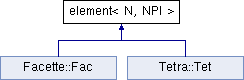
Template abstract class, mother class for tetraedrons and triangles. More...
#include <element.h>
Public Member Functions | |
| element (const std::vector< Nodes::Node > &_p_node, const int _idx, const std::initializer_list< int > &_i) | |
| constexpr int | getN (void) const |
| constexpr int | getNPI (void) const |
| void | buildMatP (Eigen::Ref< Eigen::Matrix< double, 2 *N, 3 *N >> P) |
| virtual Eigen::Matrix< double, Nodes::DIM, NPI > | getPtGauss (void) const =0 |
| void | infos (void) const |
| virtual Eigen::Matrix< double, NPI, 1 > | charges (const double &Ms_or_dMs, const std::function< Eigen::Vector3d(const Nodes::Node &)> &getter) const =0 |
| bool | existNodes (void) const |
Public Attributes | |
| std::array< int, N > | ind |
| int | idxPrm |
| Eigen::Matrix< double, NPI, 1 > | weight |
| Eigen::Matrix< double, 2 *N, 2 *N > | Kp |
| Eigen::Matrix< double, 2 *N, 1 > | Lp |
Protected Member Functions | |
| const Nodes::Node & | getNode (const int i) const |
Private Member Functions | |
| virtual void | orientate ()=0 |
Private Attributes | |
| const std::vector< Nodes::Node > & | refNode |
Detailed Description
template<int N, int NPI>
class element< N, NPI >
Template abstract class, mother class for tetraedrons and triangles.
template parameters are N number of sommits and NPI number of interpolation points. It contains a list of indices to the N nodes of the element, a reference to the full nodes vector, and index refering to the associated material parameters. All indices are zero based. It contains also the vector and matrix weight, Kp, Lp, P related to finite element computations. weight values are not initialized, they have to be set by derived class constructor. Member function getPtGauss() returns Gauss points. orientate() is a pure virtual function, it should manipulate indices to orientate positively the element.
Constructor & Destructor Documentation
◆ element()
|
inlineexplicit |
constructor
- Parameters
-
_p_node vector of nodes _idx index to params _i indices to the nodes
Member Function Documentation
◆ buildMatP()
|
inline |
build matrix P direcly from ep,eq in nodes P is block diagonal: ( Epx Epy Epz ) ( Eqz Eqy Eqz ) with each block E(p|q)(x|y|z) a N*N diagonal matrix see here http://eigen.tuxfamily.org/dox-devel/TopicTemplateKeyword.html for the wierd template syntax
- Parameters
-
[out] P block diagonal matrix
◆ charges()
|
pure virtual |
Compute the magnetic charges on the element. The first parameter is Ms on a volume element, and dMs on a surface element.
Implemented in Tetra::Tet, and Triangle::Tri.
◆ existNodes()
|
inline |
returns true if all mesh node indices in ind are referring to existing nodes in refNode. It does not test if two indices are equal, so this function does not detect degenerated element
◆ getN()
|
inlineconstexpr |
getter for N
◆ getNode()
|
inlineprotected |
returns reference to node at ind[i] from mesh node vector
◆ getNPI()
|
inlineconstexpr |
getter for NPI
◆ getPtGauss()
|
pure virtual |
computes Gauss point of the element, return in result
Implemented in Triangle::Tri, and Tetra::Tet.
◆ infos()
|
inline |
print the vector index of the associated region and the node indices of the element
◆ orientate()
|
privatepure virtual |
a method to orientate the element. It should also call exit if element is degenerated
Implemented in Triangle::Tri, and Tetra::Tet.
Member Data Documentation
◆ idxPrm
| int element< N, NPI >::idxPrm |
index of the material region of the element
◆ ind
| std::array<int,N> element< N, NPI >::ind |
indices to the nodes
◆ Kp
| Eigen::Matrix<double,2*N,2*N> element< N, NPI >::Kp |
matrix for integrales
◆ Lp
| Eigen::Matrix<double,2*N,1> element< N, NPI >::Lp |
vector for integrales
◆ refNode
|
private |
vector of nodes
◆ weight
| Eigen::Matrix<double,NPI,1> element< N, NPI >::weight |
weights hat function of the element
The documentation for this class was generated from the following file:
- src/element.h